Enterprise-Grade Omada Mesh Network for a Two-Building Property in Daher
A homeowner in Daher suffered constant Wi-Fi drops and outages across 7–8 standalone access points. UltraTech rebuilt the network around TP-Link Omada with a wired backbone unifying the main house and Diwaniya on one managed system.
The job in short
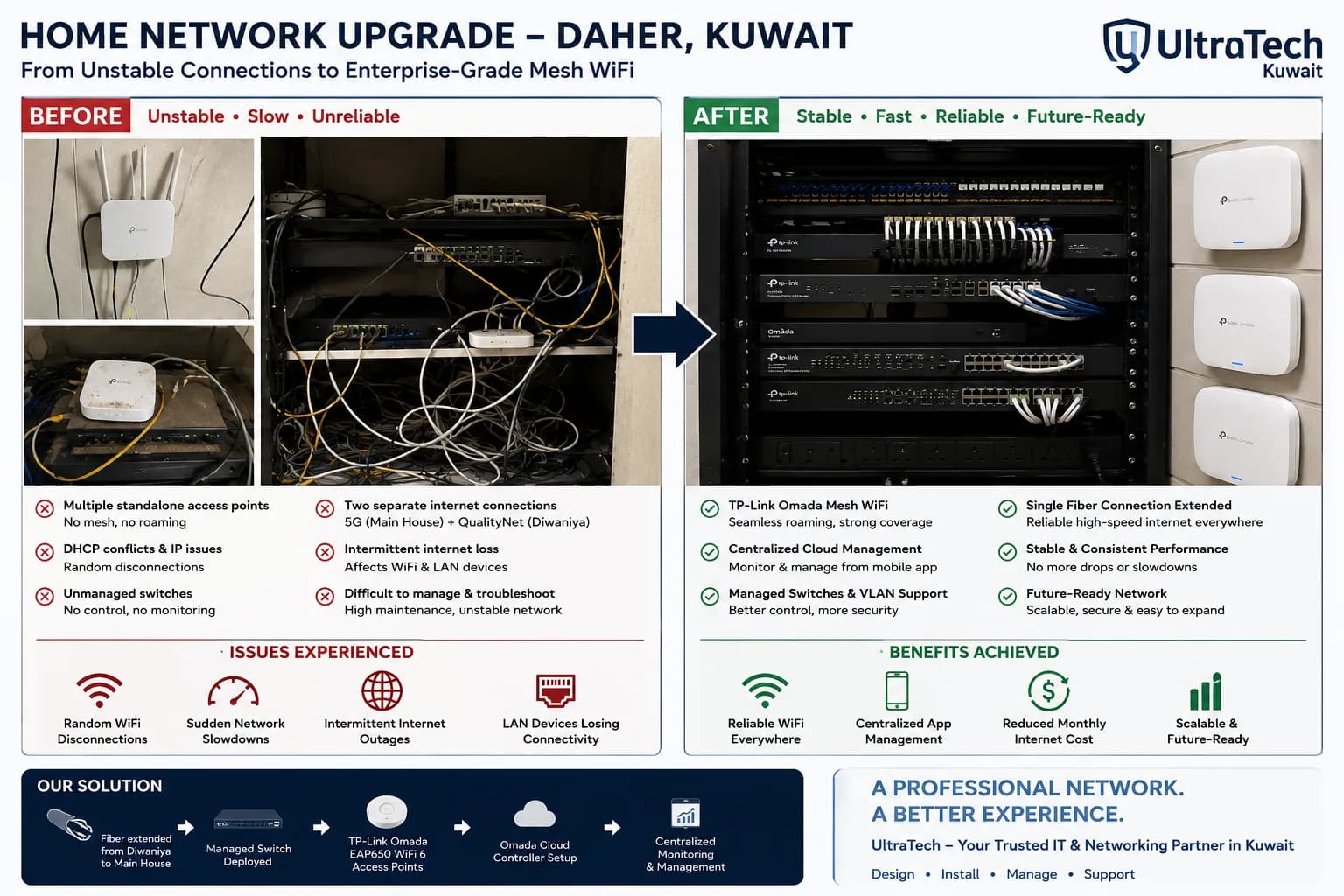
UltraTech rebuilt an unstable two-building home network in Daher, Kuwait: 7–8 standalone TP-Link TL-WA1201 access points and unmanaged switches were replaced with TP-Link Omada EAP650 AX3000 Wi-Fi 6 access points under one controller, with the QualityNet fiber line extended to both buildings over a wired backbone. The redesign eliminated DHCP conflicts and random disconnections, added seamless roaming, and cut monthly internet costs.
- Buildings unified
- 2
- Old APs replaced
- 7+
- Wi-Fi standard
- Wi-Fi 6
- Controller
- 1
At a glance
- Area
- Daher, Kuwait
- Property
- Main house and a separate diwaniya building
- Client
- Residential
Equipment brands
 TP-Link
Before and after
| Before | After |
|---|---|
| 7–8 standalone access points, no controller | TP-Link Omada Wi-Fi 6 managed from one controller |
| Two internet lines: 5G in the house, fiber in the diwaniya | One fiber line for the whole property over a wired backbone |
| DHCP conflicts after restarts and power cuts | One DHCP authority, quick recovery |
| No roaming between buildings | Seamless roaming between the house and the diwaniya |
| Monthly fees for two lines | Lower monthly internet cost |
The problem
The property — a main house on a 5G internet service (500–600 Mbps down, 30–40 Mbps up) and a separate Diwaniya on a 100 Mbps QualityNet fiber line — had been unstable for an extended period: random Wi-Fi disconnections, sudden slowdowns affecting every user, and outages hitting wired devices as well as wireless.
The site survey found the cause: 7–8 standalone TP-Link TL-WA1201 access points operating independently with no controller, several unmanaged budget switches, no roaming coordination, and conditions that allowed DHCP conflicts — after a router restart or power interruption, devices received wrong IP assignments and the whole network could take a long time to recover.
What we did
Rather than patching the fragmented setup, UltraTech redesigned the infrastructure around a centrally managed TP-Link Omada system.
The QualityNet fiber connection was extended from the Diwaniya to the main house over a dedicated wired backbone, removing day-to-day dependency on the 5G line. All standalone access points were replaced with Omada EAP650 AX3000 (Wi-Fi 6) enterprise access points managed from a single Omada controller, giving seamless roaming across both buildings, a single DHCP authority, and an infrastructure ready for future expansion.
The result
The property now runs as one reliable network: no more random disconnections, seamless roaming as residents move between the main house and Diwaniya, stable performance for smart-home devices and streaming, and centralized monitoring of every access point and switch.
Consolidating onto the fiber line also reduced the client's monthly internet costs by removing the need to keep the 5G subscription as the primary connection.
Equipment used on this job
What we installed, how many, and what each device does here.
- TP-Link Omada EAP650 AX3000 Wi-Fi 6 access points — Replaced every standalone access point in the main house and the diwaniya; one controller, seamless roaming across both buildings.
- 1×TP-Link Omada controller — Manages every access point and switch from one place, with one DHCP authority.
- Wired fiber backbone between the diwaniya and the main house — Carries the QualityNet fiber line to the main house, so the 5G line is no longer the main connection.
What other owners can learn from this job
- 1More access points do not fix Wi-Fi if each one works alone: they need one controller and one network.
- 2Two buildings on one property can share one fiber line over a cable between them, instead of paying for two.
- 3Only one device should hand out addresses (DHCP); several doing it is why a network drops after a power cut.
Questions the customer asked
Why did the old network keep disconnecting despite having many access points?
The access points were standalone units with no central controller, so they competed instead of cooperating: devices clung to weak signals, and after power events multiple devices could hand out conflicting IP addresses (DHCP conflicts), knocking the whole network offline.
How long does a similar two-building mesh installation take?
Most villa and Diwaniya projects of this scope complete within a few days, including the wired backbone between buildings, access-point replacement, controller configuration, and testing.
Can the existing internet lines be reused in a redesign like this?
Yes. In this project the existing QualityNet fiber line became the primary connection for the whole property, and the 5G service was no longer needed day to day — which lowered the monthly cost.
Planning something similar?
Send us the floor plan or a few photos on WhatsApp. An engineer replies with what the job needs and what it involves.
More projects
All projects- Project record Sabah Al-Ahmad
New Villa in Sabah Al-Ahmad: Wi-Fi, Cameras and Intercom Planned Before Plaster
A newly built villa in Sabah Al-Ahmad, cabled by the owner's electricians to our network plan while the house was still under construction, then fitted by UltraTech with whole-house Wi-Fi 6, outdoor cameras and a two-door video intercom on one network.
- 14 Wi-Fi 6 access points
- 5 Outdoor cameras
- 2 Doors on the intercom
- 6 Indoor monitors
29 Aug 2026Read - Project record Al-Siddiq
Villa in Al-Siddiq: Wi-Fi, Cameras and a Custom Two-Door Intercom in 2 Days
A villa in Al-Siddiq in its final finishing stage, surveyed, quoted and then fitted in two days with seven Wi-Fi 6 wall access points, five outdoor cameras and a custom Akuvox intercom where each of the two doors rings its own profile.
- 7 Wi-Fi 6 access points
- 5 Outdoor cameras
- 2 Doors, each with its own profile
- 2 days Installation
15 Oct 2026Read - Project record Abu Fatira
Abu Fatira Villa: From 10+ Clashing Routers to One Wi-Fi 6 System in a Day
A three-storey villa with a basement in Abu Fatira lost its whole network after a new fiber router was connected. UltraTech brought it back online on the first visit, then replaced two mesh units and more than ten old routers with 12 Ruijie Wi-Fi 6 access points in one day.
- 10+ Old routers removed
- 12 Wi-Fi 6 access points
- 200 Mbps Fiber speed in every room
- 1 day Installation
19 Sept 2026Read